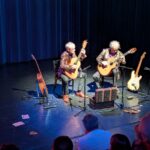
There will never be an identical replica of Sublime Escapades (uniqueness is its stylistic hallmark). This awareness is the necessary starting point for describing the Multidisciplinary Real Time Composition Performance staged on August 21, 2026, at the Ventilator Cinema in Amsterdam. It was the public outcome of the Summer Course Amsterdam , a program led by Katie Duck in collaboration with Manuela Lucia Tessi . During the performance, which lasted approximately an hour, performers of different nationalities and backgrounds activated an instantaneous composition rooted entirely in the present. There was no predetermined sequence or score to follow: the event was structured as an open relational fabric, generated and modified before the audience’s eyes. Arriving at the Ventilator Cinema means climbing to the second floor of the independent cultural center OT301, a self-managed space along Overtoom, born from the experience of an international artistic community. The room is intimate and cozy, yet charged with a dense, almost palpable atmosphere; Here, the physical proximity between performers and spectators erases perceptual filters, bringing hesitations, breathing, waiting, and microscopic shifts in intention to the fore. From this perspective, the space ceases to be a passive shell and becomes an active part of the action, amplifying its intrinsic fragility and preventing the viewer from remaining a mere detached observer.
Founded in 2009, the Summer Course Amsterdam was born as an incubator and platform for transversal research, bringing together artists working in the fields of body language, sound, theater, and performance . The 2026 event, held between August 17th and 22nd, featured two distinct phases. The first two afternoons of Multidisciplinary Workshops , under the direction of Katie Duck, were followed by three days of collective inquiry aimed at structuring the final interventions. It’s interesting to note how the very concept of “rehearsal” here loses all traditional nuance, as the goal lies not in memorizing a fixed sequence to be re-executed, but rather in exploring common ground; it’s about sharpening mutual responsiveness to legitimize the impromptu decisions made in the heat of the moment.
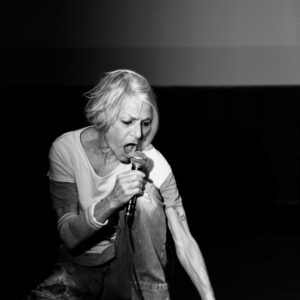
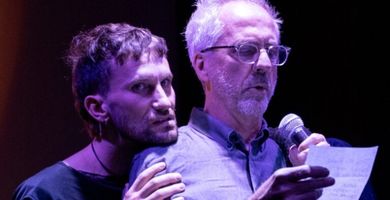
A moment from the 2025 workshop
© Roman Zotter
Katie Duck is a leading figure in international improvisation research, having been active for over fifty years at the intersection of dance, sound, and theater. Born in California in 1951, but settled in Amsterdam in 1976, she spent an important artistic period in Italy, where in 1979 she founded the collective GROUP-O, attracting figures of the caliber of Virgilio Sieni , Alessandro Certini , and Charlotte Zerbey . Her career, marked by constant exchanges with choreographers, musicians, and visual artists, is based on a precise idea: improvisation is not the antithesis of composition, but the very process through which the latter manifests itself. This is a crucial theoretical point for decoding Sublime Escapades , since defining this performance as “improvised” risks evoking the misleading image of a destructured act, left to chance or the whim of the individual. The approach, however, demands from the performers vigilant attention and a constant assumption of collective responsibility. In Duck’s poetics, just three basic elements—the pause, the flow, and the exit—are sufficient to support the dramaturgical framework; each artist is called upon to decide whether to engage with the movement, expand it, oppose it, or break it, maintaining a vigilant awareness of the sound, volumes, lighting design, other bodies, and the audience’s emotional state. Over the course of an hour, the composition takes shape and unravels before the audience’s gaze, with a constant alternation of impromptu solos, momentary attunements, and collective geometries, where no configuration ever settles into a closed form. A single gesture can trigger a shared micro-narrative or fade into isolation; a soundtrack can alter the quality of a movement, be supported, denied, or simply abandoned. The stage is saturated and emptied through constant negotiation, in which even withdrawal from the action becomes a precise compositional statement. The search for a common code does not erase the artists’ geographical and educational diversity, which remains discernible in their different embodied qualities, their ways of slicing through space, their responsiveness to sound, and the degree to which they expose their presence. Each performer preserves their own vocabulary, offering it as material for the choral architecture. It is precisely from this plurality that the performance ‘s most distinctive quality emerges: the opportunity to witness the coexistence of distant disciplines and sensibilities, without the work feeling the need to establish a formal hierarchy.
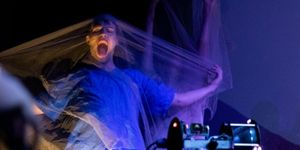
A moment from the 2025 workshop
© Roman Zotter
This is the context in which Manuela Lucia Tessi, an Italian artist active in the Dutch context, contributed. Her research focuses on the reciprocity between sound and movement. Her presence proved crucial, especially when the action threatened to slow down or become dispersed: through targeted interventions, capable of reactivating the dialogue between sound and movement, the artist refocused the group’s attention and ensured continuity to the performance , without limiting its unpredictability. Erik van de Wijdeven ‘s impromptu lighting design played a similar role , demonstrating his remarkable versatility through his participation in the action. The lighting system renounces its role as a predetermined frame to integrate itself into the instantaneous composition: the light carves out the space, reshapes the perception of bodies, and influences the volume of the actions, sharing the same margin of error as the performers . Without following a fixed pattern, the lighting reacts to the unexpected, orienting the viewer’s eye without ever tying it to a single interpretation.
The impact of Sublime Escapades transcends spectacular structure or linear narrative development; rather, it emerges from the radical impossibility of anticipating what will happen in the next instant. Viewers are asked to sharpen their attention, to capture the exact moment when an individual intention transforms into a relational dynamic, measuring the effect of each individual choice, almost feeling the latent fear of being dragged onto the stage to cooperate with the artists. The physical proximity within the theater amplifies the perception of the risk assumed by those on stage: there is no safety net or fixed structure to hold onto should the action lose intensity; all that remains is the need to refocus on the present event, ready to convert it into a new movement.
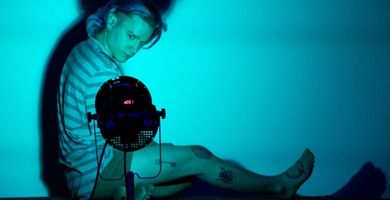
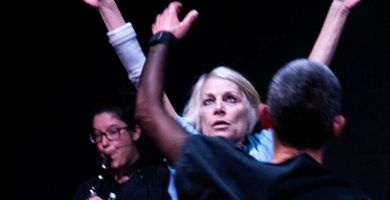
A moment from the 2025 workshop
© Roman Zotter
Naturally, effectiveness isn’t uniform across the board: at times, the simultaneous accumulation of proposals generates temporary fragmentation, while at other moments, pauses seem to excessively dilate the action’s tempo. These fluctuations shouldn’t be interpreted as simple flaws, but rather as tangible evidence of a practice that accepts the possibility of failure; eliminating all uncertainty would mean sterilizing the very element of risk upon which the implicit pact with the audience remains. When, on the other hand, collective harmony reaches its peak, the structure emerges clearly, an outcome that occurs not at the expense of improvisation, but precisely because of it. The commitment of the entire performance lies precisely in this precarious balance between order and chaos, between individual drive and shared responsibility. Katie Duck’s work isn’t aimed at producing a finished artistic object, but rather at fostering a state of alert presence. The choreographer herself, suddenly leaving her front-row seat, joins the action with a piano solo. Viewers aren’t witnessing a repetition of previously structured material: they’re faced with a work that coincides entirely with the tempo of its execution, as I was able to verify firsthand by observing the work sessions preceding the performance .
What remains, then, at the end of Sublime Escapades ? Certainly not a script to be restaged, but rather the memory of an unstable harmony between bodies, sounds, lighting, and intentions. The experience highlights how the extemporaneous can become rigorous formal architecture and, simultaneously, a rigorous training in listening to others. For an hour, the Ventilator Cinema welcomes something that goes beyond the canonical staging. The event happens, offers itself naked to the gaze, and is consummated at the same time, disappearing with the ticking of time that made it possible.